
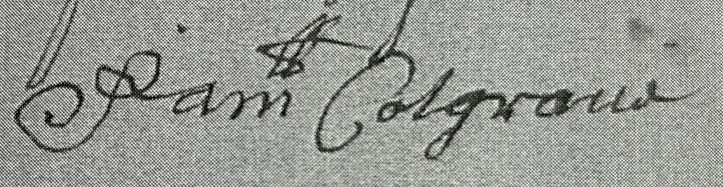
When Samuel Cotgrave moved from Chester to London, perhaps he thought the streets would be paved with gold. Born in the 1650s, he had several older brothers who were in line to inherit land in nearby Christleton and who would set themselves up as leading businessmen in the city. Benjamin, a tallow chandler, “had an estate” in Cheshire. Jonathan and John were leading brewers; John’s son, grandson and great grandson would all serve as the city’s mayor. But Samuel and his brother Peter went to London, where Peter became a successful joiner and Samuel earned a decent living as a draper and was described as a “tradesman”.
But financial dealings are risky, and on one occasion, he took his eye off the ball and came close to ruin. The story had started in 1692 when a man called Thomas Hutton had secured a patent for an “engine to be driven either by wind, sails or water wheels” which could make large quantities of paper apparently operating 80 presses at once. Hutton appears to have been a paper manufacturer from Oxfordshire and there are now few details of his invention. To fund his work, Hutton had issued 500 shares in the papermaking engine, and a merchant called Patrick Ellis had bought twelve per cent of the company, presumably expecting to profit when it was successful.
Ellis had then agreed to sell 20 of those shares to a widow called Elizabeth Man for a sum of £50, valuing the whole endeavour at £1,250. But she did not have the ready cash for her shares so she agreed to borrow it from a man called Samuel Weale, and the two of them drew up the paperwork for the loan.
Whatever happened next, Ellis claimed he never got his £50 so he sued Mrs Man and her backer Samuel Weale. In a standard tradition, he claimed twice the level of the debt – £100. It was normal for debtors to sign bonds for twice the face value as an incentive to pay up the original amount rather than end up being sued for the larger sum.
Man and Weale then claimed that the whole court case had been based on false facts and took out what was known as a writ of error, upping the ante from the everyday Court of Common Pleas to the superior Queen’s Bench Court. To bring the case they needed sureties and they convinced Samuel Cotgrave to act as one of these, telling him that a wealthy friend called William Warner would act as the other. But an important detail was that this case was not about the original debt of £50, it was about the court decision for £100. The normal custom of the sureties underwriting twice the base figure applied, so Cotgrave and Warner were now acting as sureties for £200. But it was all a formality according to Mann and Weale – the original court decision was invalid because it had been based on paperwork that had never been properly signed and executed.
Predictably, they lost the case; the higher court could find no error in the lower court’s decision, and what this meant in practice was that Samuel Cotgrave and William Warner were on the hook for £200. There was no rule that said the money had to be shared equally between the two sureties and it seems that for some reason, the authorities focused their efforts on extracting the cash from Cotgrave (at least according to his version of events). First they seized some of his goods as a way of recovering the money and he had to pay £50 and 16 shillings to get them back. Then they came again and according to Cotgrave, either the Sheriff of Middlesex or the High Bailiff of Westminster took away goods worth £250. Added to the £50 he had already paid to redeem the previous seizure, Samuel Cotgrave now claimed that he was more than £300 out of pocket. Given that the original transaction had been for £50, and that even on the most aggressive interpretation, the official amount due was now £200, and that Cotgrave was just one of two sureties, this was manifestly unjust.
Samuel Cotgrave had come to believe that the whole thing was a stitch up. He thought that Patrick Ellis, Elizabeth Mann and Samuel Weale were all in it together. And what had happened to William Warner, supposedly also a surety? He was also known to Mann and Weale. So according to Cotgrave, he was being defrauded by the four of them, who were “confederating betwixt themselves”.
This version (admittedly Cotgrave’s biased perspective) was manifestly unfair, which meant that he could involve another court. Chancery was a court of Equity, whose job was to put right unjust outcomes from the strict interpretations of the Law Courts. It was now thirteen years since the patent on the papermaking engine had been granted, and there is no evidence that it had been in any way successful. Whatever sums were being litigated, nobody seems to have been profiting from the invention.
Within a couple of weeks, Chancery issued an injunction to halt the proceedings in the law Courts, citing an affidavit of Cotgrave’s “poverty” after the loss of such a large amount; Samuel Cotgrave had won this particular battle. He still needed to recover his money, however. Because the issue was now more of a private matter of sorting out the cash than a legal dispute, the records dry up and it becomes difficult to know exactly how (or even if) the whole thing was resolved. But three years later in 1708, when Elizabeth Man wrote her will, she specified that none of her bequests could be paid until her debts had been discharged and “in particular I desire that the debt owing by be me to Mr Samuel Cotgrave may be first satisfied and paid”.
Whatever financial transactions took place, Samuel Cotgrave continued to pay his local taxes at his residence at Powell’s buildings in St Martin-in-the-Fields parish until he died. He was buried in the parish on 10 February 1714.
Sources
National Archives: C6/389/51; C24/1182, no.20; C24/1304, no.49; C33/305, folios 7r, 21r, 37r; PROB11/524.
Wakeman, F. (1999) Deddington Paper Mill in The Newsletter of the Deddington & District History Society, issue no 1, October 1999, p. 4
Westminster Archives: F438; Parish Register of St Martin the Fields
Woodcraft, B. (1854) Titles of Patents of Invention, Chronologically Arranged, from March 2 1617 to October 1 1852, London, p.59.

