
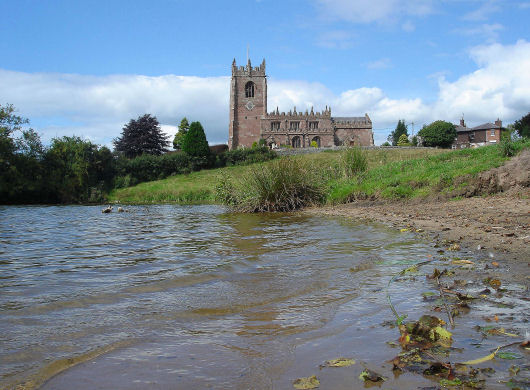
When 32-year-old Robert Cotgreave moved a few miles to Marbury on the Cheshire-Shropshire border in 1801, it seems doubtful that he appreciated quite how his family’s fortunes would play out in the village.
His elder brother had inherited the family lands, and he had to make his own way in the world. He was well educated and had made a good start by marrying well – his young bride Peggy Oakes was the daughter of a gentleman and inherited the perpetual interest on investments of £140, which at a standard 5 per cent per annum would contribute a healthy £7 to the yearly budget.
Somehow, Robert got together the cash to rent a small farm in Marbury, and he was instantly recognised as a leading member of the community – auditing the churchwarden’s accounts and serving on the jury of the local manor court as soon as he arrived, and repeatedly year after year for the rest of his life.
He and Peggy had numerous children and he must have seemed like an asset to the village when his education was put to good use and the parish began to allow him a stipend to run a Sunday school where he would “instruct young people in the psalmody”.
Within a few years, he was such an crucial part of the Marbury religious community than when the old parish clerk died, he relinquished the lease on the farm, moved to a nearby house and worked full time for the parish.

Robert was witness to and executor of various wills for local inhabitants, a juror at parish and county levels, and as his children grew up, they started to do odd jobs around the village, including washing the clergyman’s ecclesiastical vestments and clearing the pathways in the churchyard.

Although his brother was their father’s main heir, Robert was trustee of the family settlement and in 1835 had to organise what looks to modern eyes like a complicated arrangement to create a “trustee to attend the inheritance” – a nominal single owner with the legal right to sell lands in Hawarden that belonged to Robert, his siblings and nephew in different shares.
Then in 1844, already in his 70s, Robert Cotgreave was appointed village schoolmaster.
His family grew, with sons moving to Manchester, London and Berkshire to pursue economic opportunities, most of his daughters marrying various locals, and one of them remaining unmarried and becoming the local postmistress. Despite their respectable status, more than one of the women in the family ended up having illegitimate children, one of whom, Robert’s grandson Thomas Cotgreave, grew up to become the miller at Marbury mill.
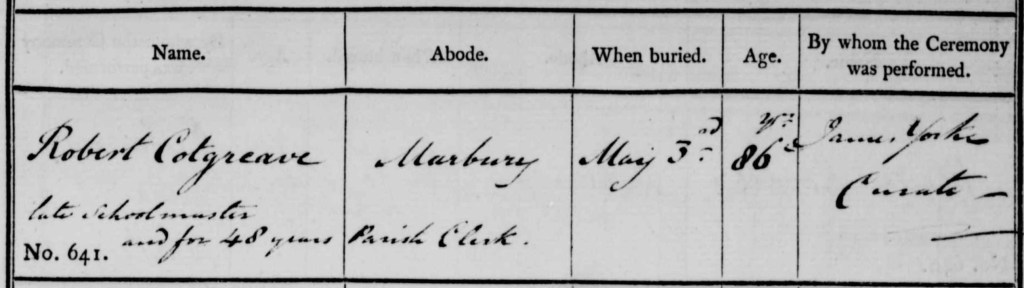
When Robert Cotgreave died in 1855 at the age of 86, his handwriting was shaky but his reputation was secure. In the box marked “name” in the parish register, into which was almost always written exactly that – someone’s name and nothing else – the priest recorded that Robert had been “for 48 years Parish Clerk”.

Sources
Liverpool University Special Collections LUL MS 90.
Cheshire Archives and Local Studies: Land Tax for Marbury; Tithe maps for Marbury; P39/83; Parish Registers for Marbury; WS Thomas Oakes 1807; WS Edward Lee 1831; WS John Parrey 1829; WS James Eaton 1826; WS Ann Webster 1826; WS Elizabeth Wright 1840; WS Robt Cotgreave 1855; WS Emma Cotgreave 1863; EDC8 30 Nov 1807.
Abstract of Returns of Charitable Donations [1816], p.129
National Archives: ASSI66/1; CHES18/28
Chester Chronicle 8 May 1835
National Library of Wales: HA 1835 213
Civil certificates of marriage and death
Post Office Museum: POST58/79 minute 2487
 Possessing Antiquity